
1. Global Search Market Volume
Using “mealworm” as the core keyword and adding terms such as “wholesale,” “suppliers,” “factory,” and “manufacturers” for precise targeting, Google Keyword Planner data shows that only a small number of searches are related to wholesale terms. Most searches are focused on “bulk” purchasing.
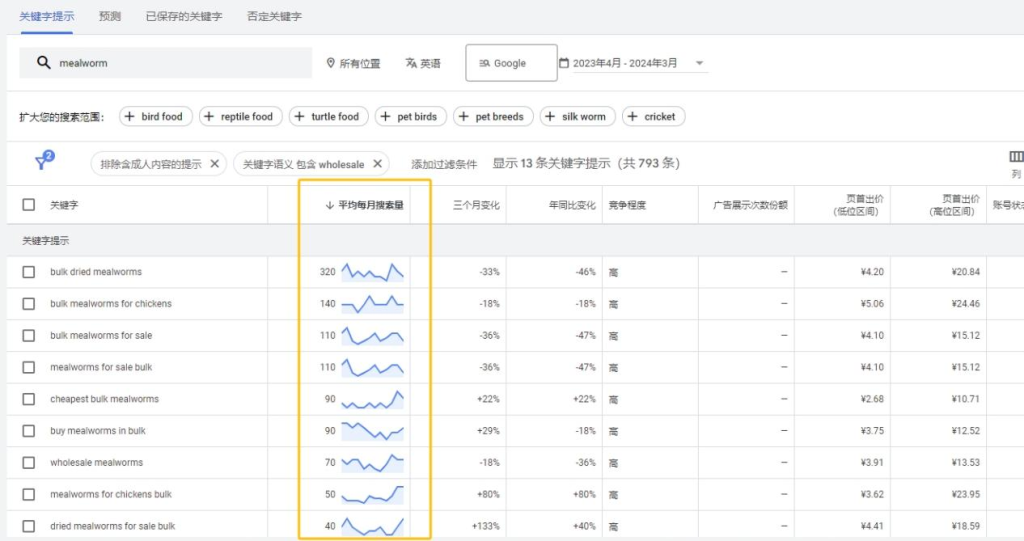
Figure: Google Keyword Planner
The data shown above is based on global targeting with English as the search language. The search volume represents monthly averages.
Currently, the global monthly search volume for mealworm-related keywords is estimated at 1,000+ searches per month.
The high frequency of “bulk” searches indicates that the main user groups are likely:
- Pet owners purchasing larger quantities
- Small-scale farmers
- Insect farming enthusiasts
The market does not appear to have strong wholesale demand. The average order value may not be high, and the demand is more likely for large retail packages of mealworms rather than traditional wholesale orders.
Currently:
- “wholesale mealworm” receives approximately 40+ monthly searches
- Other keywords such as “factory,” “supplier,” and “manufacturer” show little or no measurable search volume
2. Competitor Analysis from Google Search Results
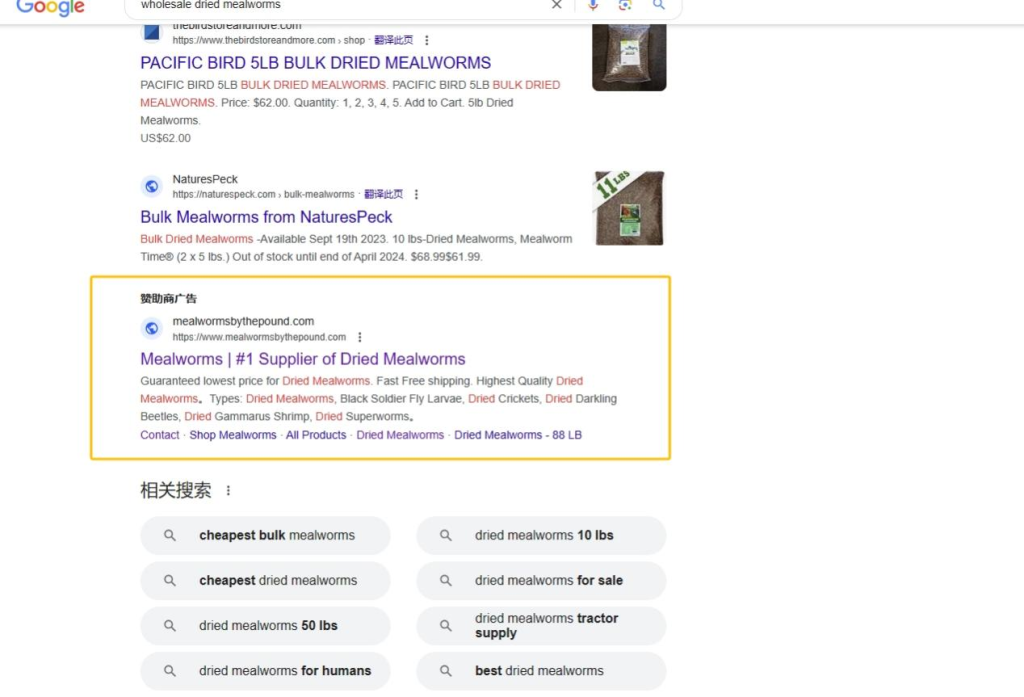
After switching to a US IP location and searching the main keyword “wholesale dried mealworms,” the following competitors appeared.
There are two independent websites actively running Google Ads.
Competitor 1: Mealworms By The Pound
This appears to be a local US supplier. Their positioning focuses on being a direct/source mealworm supplier.
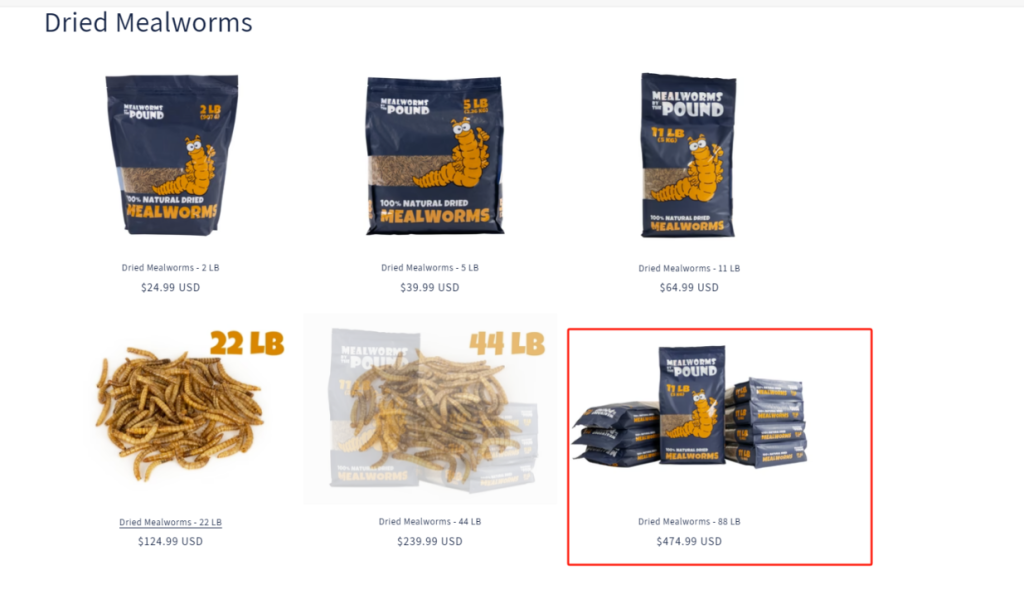
Website:
https://www.mealwormsbythepound.com/
Pricing:
- 88 lbs = USD 474
- Approximate price: USD 43.8/kg (about RMB 43.8 per jin)
Marketing positioning:
- Local supplier image
- Bulk purchase focus
- Direct supply messaging
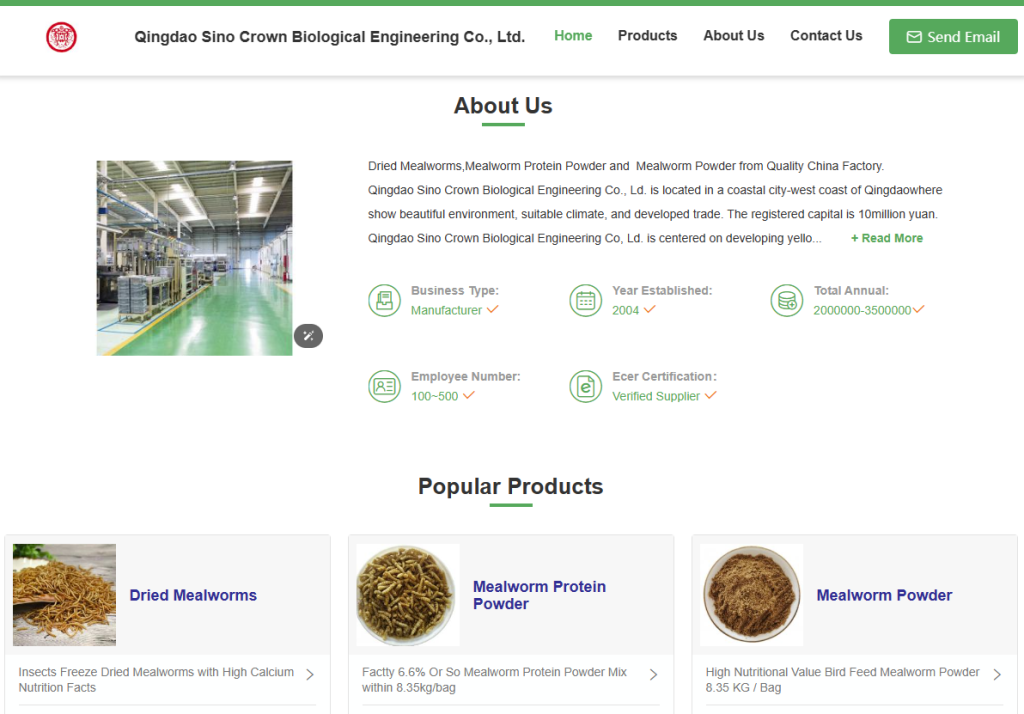
Competitor 2: Qingdao Huaguan Bioengineering (China Supplier)
A Chinese supplier that appears to be running ads for multiple related keywords.
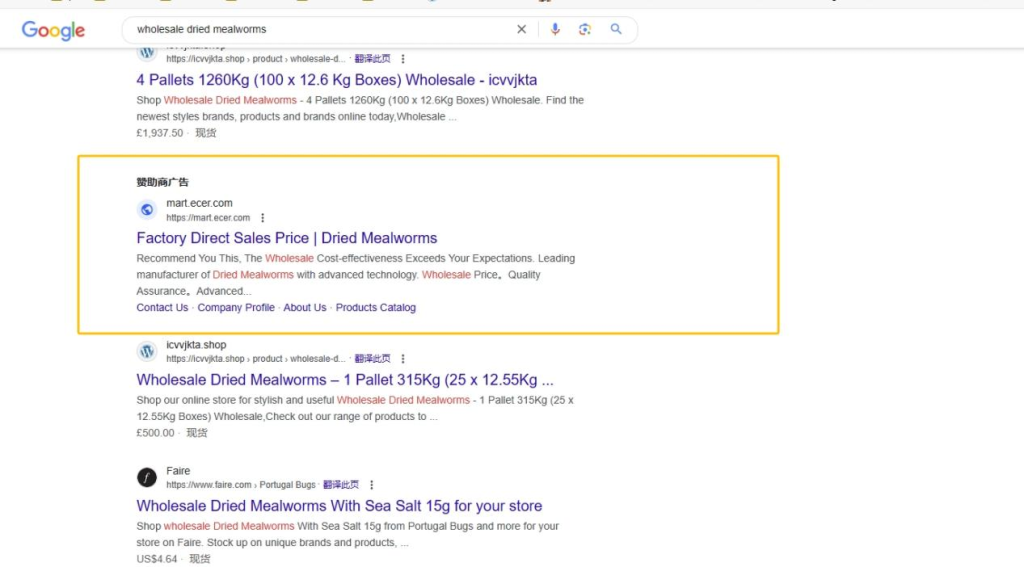
Website:
https://mart.ecer.com/drymealworm/
Pricing:
- No public pricing displayed
- Customer acquisition mainly through inquiry forms
Marketing model:
- B2B inquiry-based sales
- Focus on supplier/manufacturer positioning
Competitor 3: Amazon Retail Market
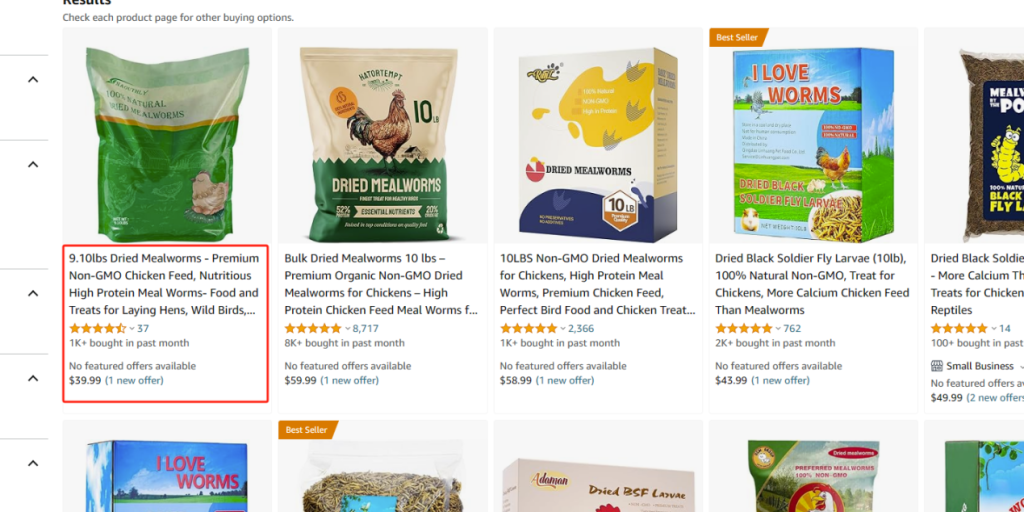
Example retail product:
Pricing:
- 9.1 lbs = USD 39.99
- Approximate price: USD 36/kg (about RMB 36 per jin)
Positioning:
- Consumer retail
- Smaller package sizes
- Higher brand premium potential
3. Advertising Campaign Analysis
Advertising Feasibility
Based on Google Ads backend data and front-end search results, if logistics costs and final selling prices can be controlled, the product could potentially be tested through small-batch advertising campaigns.
The goal would be to collect market data and evaluate:
- Long-term repeat purchase opportunities
- Potential for larger B2B orders
- Customer acquisition cost
- Actual market demand
Estimated Advertising Model
| Item | Estimate |
| Cost per click (CPC) | RMB 5/click |
| Monthly clicks | 1,000 |
| Conversion rate | 3% |
| Average order value | RMB 1,500 |
| Customer acquisition cost | RMB 166/order |
| Estimated monthly orders | 30 orders |
Based on this model:
- Monthly advertising traffic: approximately 1,000 visitors
- Expected orders: around 30
- Advertising cost per order: approximately RMB 166
Cost Analysis
Assuming Alibaba sourcing prices:
Option 1: Air/Express Logistics
Product cost:
- RMB 13.8/jin
Shipping cost:
- RMB 20/jin
Total landed cost:
RMB 33.8/jin
Option 2: Sea Freight
Product cost:
- RMB 13.8/jin
Shipping cost:
- RMB 14/jin
Total landed cost:
RMB 27.8/jin
Market Positioning and Pricing Analysis
Currently, the US market price for mealworms is approximately:
RMB 30–50/jin
White-label products are significantly cheaper than branded products, making pricing strategy difficult.
Based on current market conditions:
- The profit margin may be limited
- Competing directly with existing retail sellers may be challenging
- Brand differentiation will be important to achieve higher pricing
Conclusion
From the current Google Ads research:
- Only two independent websites were found actively running paid advertising for mealworm-related keywords.
- One is a local US supplier.
- One is a Chinese source factory.
- The number of advertisers is relatively low.
This situation could indicate two possibilities:
- The market competition is low and there may be an opportunity for new entrants.
or
- The advertising ROI is not attractive, resulting in limited advertiser participation.
Further testing through a small-budget Google Ads campaign is recommended before large-scale investment.
The initial strategy could focus on:
- Testing consumer bulk purchase demand
- Measuring actual conversion rates
- Evaluating repeat purchase behavior
- Identifying whether B2B wholesale opportunities exist
Based on current data, mealworm advertising appears suitable for small-scale market validation, but the profitability and scalability require further verification.