
A tray of mealworms can look surprisingly quiet. The eggs are almost impossible to spot, and a pupa may sit so still that it looks like nothing is happening. Then one day, a dark beetle appears. What happened?
They are all the same insect at different points in its life. A mealworm is the larval stage of the yellow mealworm beetle, Tenebrio molitor. Like butterflies, these beetles go through complete metamorphosis: egg, larva, pupa, and adult. [University of Maine Cooperative Extension]
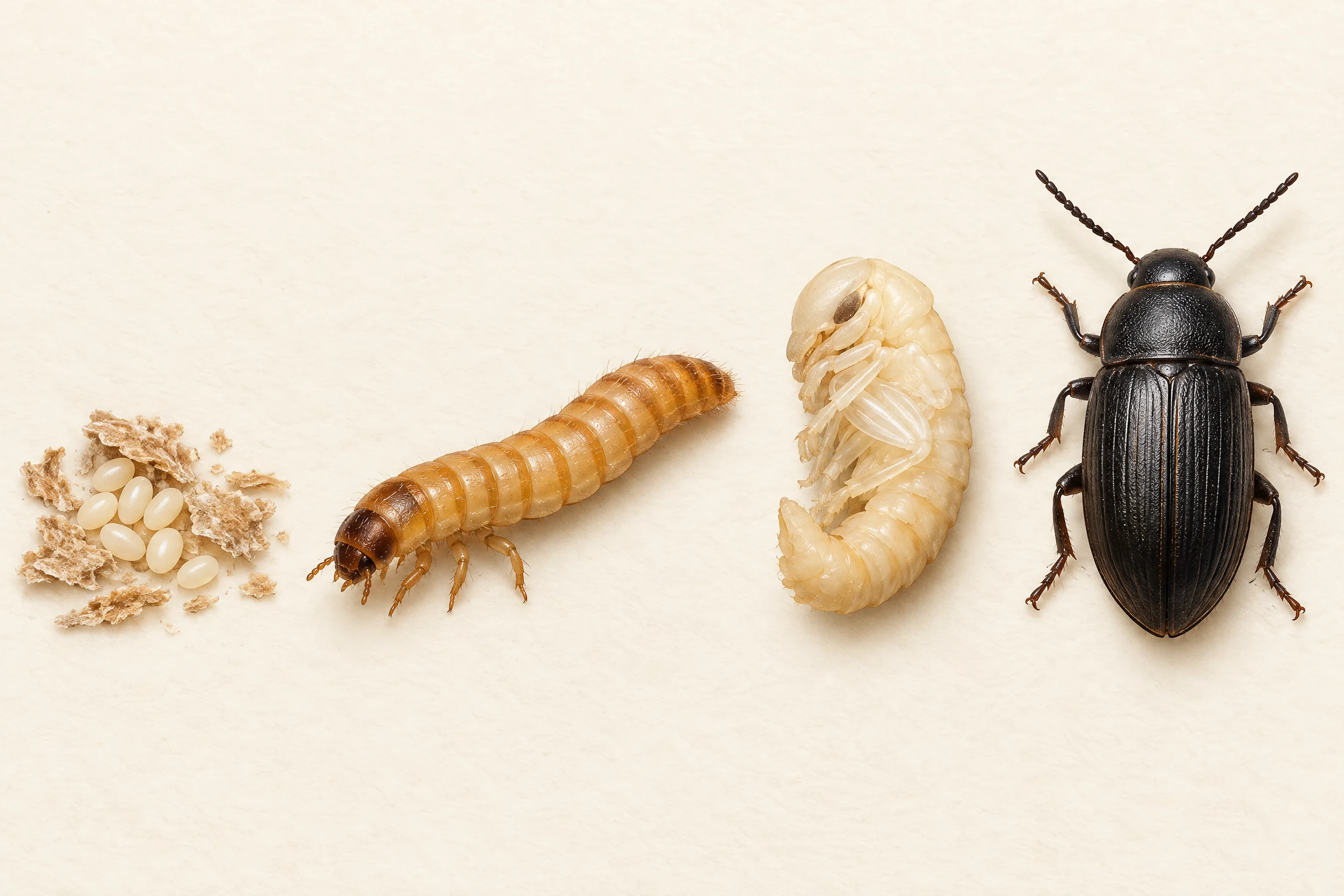
Mealworm life cycle at a glance
There is no one-size-fits-all calendar for mealworms. Temperature, food, moisture, and other rearing conditions can speed up or slow down development. These ranges are useful starting points, not deadlines:
- Egg: about 1 to 4 weeks to hatch.
- Larva: around 8 to 10 weeks in a fast, warm colony, but several months in slower conditions.
- Pupa: often about 1 to 3 weeks.
- Adult beetle: usually lives for about 2 to 3 months.
The larval stage is where timing varies most. One home-rearing guide gives an estimate of 8 to 10 weeks. University of Maine Cooperative Extension says a newly hatched larva may take 6 to 9 months to mature. In a controlled study, development from egg hatch to pupation averaged about 185 days at 68°F (20°C ) and 136 days at 86°F (30°C). The takeaway is simple: treat any timeline as an estimate, because conditions matter. [Mealworm Care] [University of Maine Cooperative Extension] [Eberle et al., 2022]
1. Egg: A tiny beginning
After mating, a female beetle lays tiny, pale eggs in the food or bedding. The eggs are easy to miss because they can stick to the substrate and quickly get covered in dust or bran. A tray may look empty even when it holds eggs.
Depending on conditions, eggs may hatch in about a week or take several weeks. The hatchlings are very small and pale, so give them time to grow before deciding that nothing has hatched. [Mealworm Care]
2. Larva: The familiar mealworm
This is the stage most people picture when they hear the word “mealworm.” The larva spends its time eating and growing. Its hard outer shell cannot stretch as its body gets bigger, so the larva sheds that shell again and again. This process is called molting.
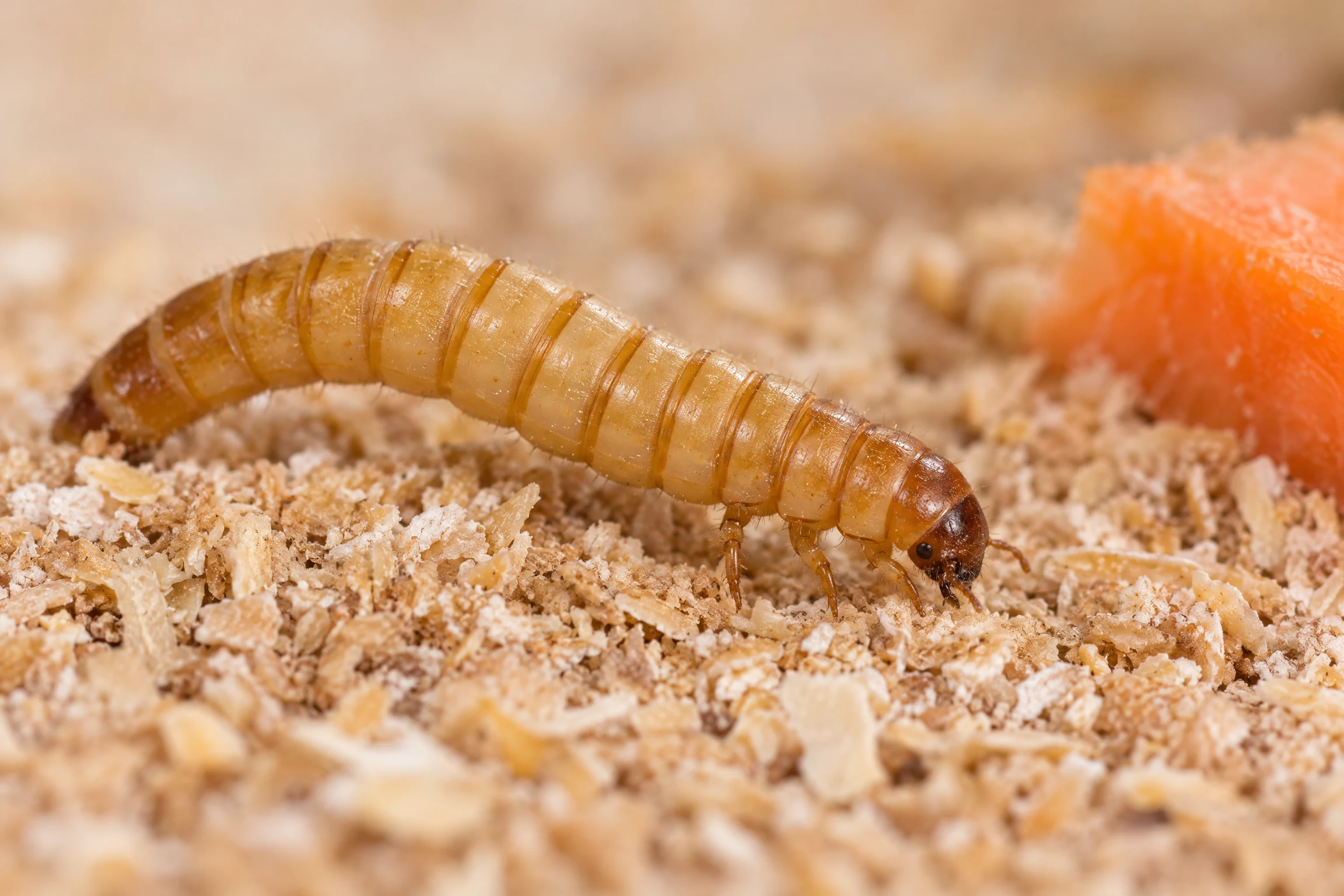
Right after a molt, a larva may look almost white. Its new outer shell darkens and hardens as it grows. The number of molts and the time spent as a larva can vary, so two mealworms in the same colony may not change at exactly the same pace. [Mealworm Care]
3. Pupa: A quiet transformation
When a larva is ready, it stops feeding and becomes a pupa. From the outside, this can look like the quietest part of the cycle. The pupa does not eat and barely moves, while its body changes into the adult form.
A healthy pupa is often pale at first and may twitch if disturbed. It does not need to look busy to be developing. After roughly 1 to 3 weeks in many home-rearing guides, a beetle emerges, though the exact timing can vary. [Mealworm Care]
4. Adult: The darkling beetle
The newly emerged beetle starts out pale and soft. Over the next few days, its outer shell hardens and darkens to brown or black. This adult is a darkling beetle—not a giant mealworm—and it is the stage that reproduces.
After mating, female beetles lay eggs in the substrate, and the cycle begins again. Adult beetles usually live for about 2 to 3 months, although their lifespan and egg production depend on conditions. [University of Florida IFAS]
How long does the full mealworm life cycle take?
Under ideal rearing conditions, the egg-to-egg cycle can take as little as 4 months. In less favorable conditions, it can take much longer—University of Maine Cooperative Extension notes that a full cycle often lasts more than a year. Temperature is one important factor, but food, moisture, and the colony setup matter too. [University of Maine Cooperative Extension]
So if your mealworms do not follow a neat weekly schedule, that is normal. Watch for the changes in front of you: tiny larvae after hatching, repeated molts as they grow, a still pupa, and finally a dark beetle. Those four stages tell the whole story.
Frequently asked questions
What do mealworms turn into?
Mealworms turn into pupae, and pupae become adult darkling beetles. The mealworm is the larval stage of the beetle.
Are mealworms actually worms?
No. They are insect larvae. The yellow mealworm is the larva of Tenebrio molitor, a darkling beetle.
Why do mealworm life-cycle estimates vary?
Temperature, food, moisture, and other rearing conditions affect how quickly mealworms develop. That is why one source may describe a few months while another reports a much longer cycle.